

Key messages
- A long-term people-centred vision anchors immediate actions and informs strategic decision-making.
- Data and evidence are the foundation for people-centred justice and security programming.
- Including diverse perspectives, especially those most often excluded, is essential to understanding justice and security challenges.
- Understanding the system involves stakeholder mapping, PPEA, conflict analysis and systems mapping.
- Analysis examines how justice and security systems function and why they produce the outcomes they do.
4.1 Introduction
Understanding justice and security requires looking at the systems that shape them from two distinct but interconnected angles:
- A user-facing perspective—how people experience justice and security in their daily lives.
- A system-facing perspective—how justice and security institutions, power and relationships interact to produce those outcomes.
This section helps teams bring both perspectives together to create a shared understanding of why people’s justice and security needs are not being met and what might need to change for systems to be more accessible, accountable and responsive to the needs of all people, especially the most vulnerable and marginalized.
A people-centred approach begins with understanding justice and security problems as people experience them, analysing how the system functions, and diagnosing why people’s needs are not being met. The aim is to generate a strategic understanding that supports adaptive, inclusive and impact-driven programming.
While it is essential to invest time in this process, programming often takes place under tight timelines and resource constraints. Step 1 is not expected to be completed in full from the outset. Instead, treat it as an iterative process that evolves over time. Where possible, include activities that generate data and insight, such as perception studies, stakeholder dialogues and legal needs assessments, as part of project design and delivery. These activities not only improve analysis but also strengthen the responsiveness and relevance of programming throughout implementation.
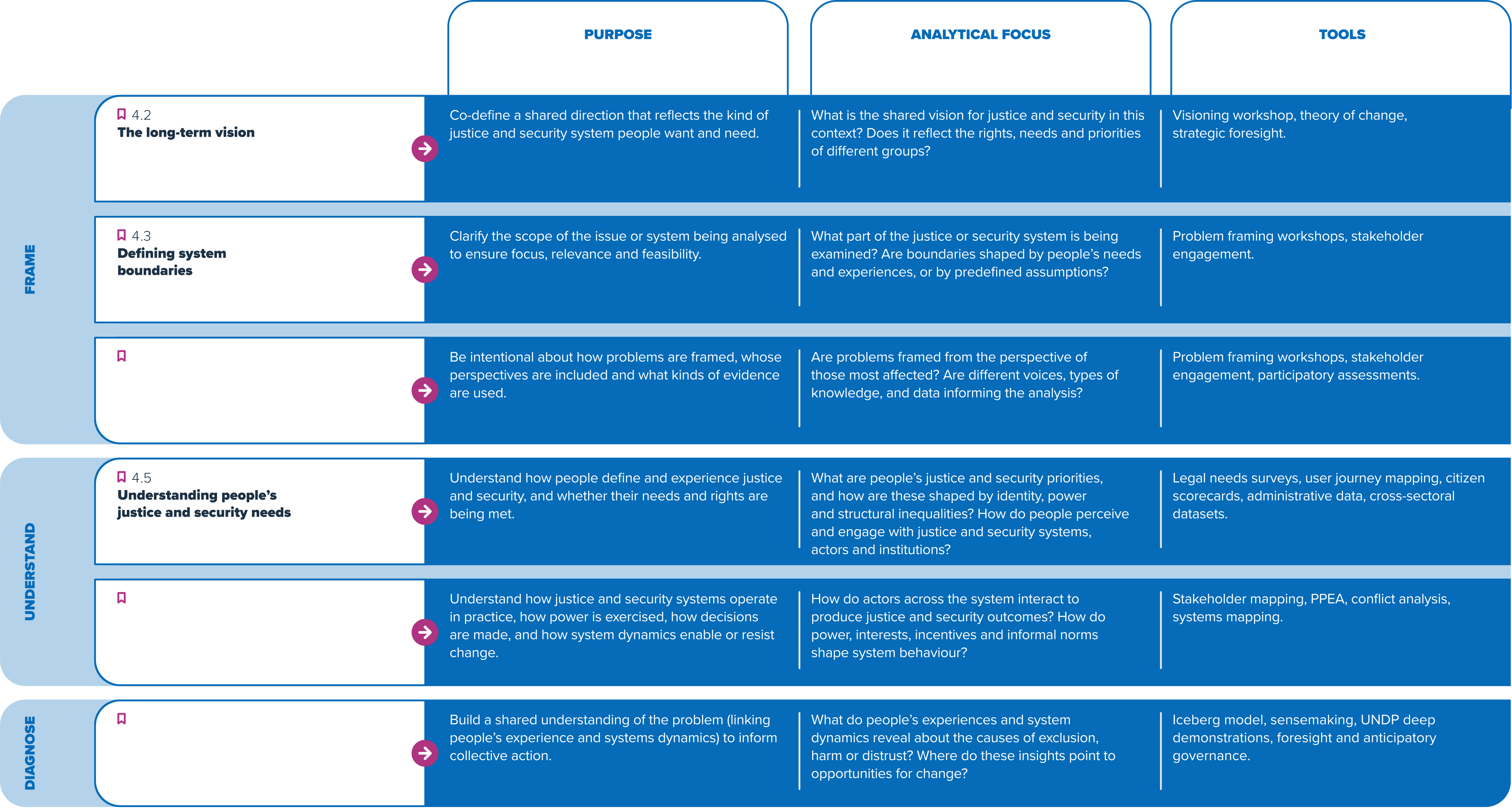
See Diagram 4 for an overview of the key components of Step 1 and how they fit together as an integrated, iterative problem analysis process.
This analysis also provides a valuable opportunity to engage donors strategically. Donors may not always have a full understanding of local dynamics. Sharing robust, evidence-informed analysis can help shift assumptions, highlight overlooked actors or drivers, and point to areas where donor investment could catalyse meaningful change.
It also strengthens value-for-money arguments by identifying targeted opportunities for early impact that are aligned with broader, long-term transformation goals.

Diagram 4: Step 1 at a glance—Building a strategic understanding of the problem
4.2 The long-term vision
Effective people-centred justice and security programming is guided by a long-term vision of justice and security systems that are accessible, fair, inclusive, accountable and responsive to the rights and needs of all people, especially those most at risk of being left behind.

This vision is grounded in justice, security, and human rights and reflects global and national commitments, including the 2030 Agenda’s call for peaceful, just and inclusive societies (SDG 16). Justice and security are fundamental public goods, essential for upholding the rule of law, ensuring accountability and sustaining the social contract. The State is responsible for ensuring their provision, and people are entitled to access them without discrimination.
While the core values of a people-centred system reflect global norms and commitments, the specific vision must be grounded in local context. In each setting, the long-term goal should be collectively defined through inclusive dialogue with State, non-State and community actors. This ensures the vision is legitimate and contextually relevant, and provides a shared foundation for prioritization and implementation.
Once the vision is co-defined, the pathway to achieving it will vary across contexts. What is prioritized first and how progress unfolds depends on context-specific factors such as political dynamics, security conditions, institutional capacity and people’s immediate priorities. For example, in conflict-affected or fragile settings, early steps may focus on restoring safety, rebuilding trust and enabling people to resolve disputes and access protection locally. In more stable environments, efforts may concentrate on strengthening oversight, accountability and the quality of services. The sequence will differ, but each step should move systems closer to the overarching goal.
The vision is a practical reference point for analysis, action and adaptation throughout the programming cycle (see Box 3). It guides analysis, shapes how problems are defined, helps teams set priorities and provides criteria for assessing progress. By keeping attention on things that matter to people, such as fairness, trust and inclusion, it ensures that system-level change is grounded in people’s actual experiences of safety, justice and rights, rather than focusing only on short-term or purely institutional outputs.


4.3 Defining system boundaries
With the long-term vision in mind, the next step is to clarify the boundaries of the justice or security system being examined.
This means deciding what to focus on and what to set aside, based on the purpose of the work. In most cases, teams are analysing not an entire justice or security system, but rather a specific part or issue, such as informal justice, community safety, legal identity or digital case management.
Boundaries may be shaped by:
Purpose: What is the issue we are trying to understand?
Opportunity: For example, a request from a government partner, a donor-funded initiative, or a new policy or law that opens a programming opportunity.
Feasibility: The time and information available, and which actors are accessible and can be engaged.
Setting clear boundaries at the start of the analysis helps teams:
Focus on what is relevant and actionable.
Avoid getting overwhelmed by the complexity.
Stay aligned with the problem they are trying to understand or address.
However, boundaries are not fixed. As learning deepens, teams may need to adjust the scope of their analysis to reflect new insights, include overlooked stakeholders or respond to context changes.
How a problem is initially framed also shapes where boundaries are set. If the framing is based on assumptions or predefined solutions, it can exclude critical parts of the system or overlook potential entry points.
For example, framing the problem as “weak law enforcement” might narrow the focus of the analysis to police capacity or operations. This risks overlooking wider issues that may be contributing to policing ineffectiveness, such as a breakdown in trust between communities and police, lack of accountability or unresolved grievances. By contrast, framing the issue around “public safety” or “rebuilding trust” can lead to a broader inquiry that includes the role of justice and security actors, community dynamics, oversight mechanisms and other factors that are combining to shape people’s experiences of safety and security, enabling a wider set of strategies to be used to improve outcomes.
Framing and boundary-setting should be considered together, and both should remain open to revision throughout the process. As teams engage with stakeholders and gather new insights into how the system works, they may need to reframe the issue. A learning mindset helps treat analysis as an evolving process.

A practical starting point is to identify the core system essential for understanding the issue and then expand outward as needed. Relationships and interconnections across the system are important, but not everything needs to be analysed at once.
For example, if the issue is lack of access to legal identity, the core system might include civil registration authorities, local government offices, and religious or traditional leaders, as well as legal aid providers or community paralegals. As analysis progresses, it may expand to include schools, health facilities or security actors who play a role in verifying identity or enabling access to public services.
4.4 Foundations for effective diagnosis
This section introduces three foundational enablers that influence how justice and security systems are analysed. They help ensure that analysis remains focused on people’s rights and needs throughout the process.
To generate meaningful insights that can inform programming decisions, teams need to be intentional about how problems are framed, whose perspectives are included, and what kinds of evidence are used. These three enablers support all aspects of the Step 1 process.
4.4.1 Framing and reframing problems
How a problem is framed influences what we see, who we listen to, which dynamics we prioritize and what types of solutions are considered possible. Teams often begin with a predefined topic, such as e-justice or community policing. These entry points may reflect institutional interests, donor agendas or political priorities rather than the actual justice and security problems people face, especially those most vulnerable and marginalized.
- A people-centred approach invites teams to pause and consider:
- What problem is being defined and on what basis?
- Whose perspective does this framing represent?
For example, a team may be asked by a partner, donor or UNDP unit to explore opportunities for e-justice. But this framing starts with a proposed solution—digital tools—rather than a clearly defined, people-centred problem. While digitalization can support access to justice, transparency and efficiency, it is not inherently transformational unless it responds to people’s actual needs, the barriers they face and their levels of trust in justice systems.
If, for instance, a core issue is that women do not feel safe reporting violence or marginalized groups distrust State institutions, a digital platform alone may not improve access to justice and could even reinforce exclusion. Reframing the issue through a people-centred lens helps to uncover deeper drivers of injustice such as stigma, fear or lack of accountability. It clarifies when and how digital tools can support change and when other types of interventions are needed.
Framing is the foundation for good diagnosis. It helps ensure that analysis stays grounded in people’s rights and needs, and is not limited by technical, institutional or pre-set agendas.
Framing is also shaped by mental models. These are the underlying beliefs all people carry, often unconsciously, about what justice and security mean, how institutions should function and how change happens. These beliefs influence how problems are defined, who is seen as legitimate and what kinds of responses are valued.
A people-centred approach requires teams to reveal these assumptions, seek out multiple perspectives, and remain open to different ways of understanding what is working, what is flawed, and what matters most to people (see Section 3.3.3, ii).
4.4.2 Engaging diverse perspectives
People-centred analysis requires engaging a broad range of perspectives, including the perspectives of people who are often excluded from formal decision-making.
People experience justice and security systems differently depending on factors such as gender, age, ethnicity, religion, disability, social status and experience. These differences shape how problems are understood, which justice and security actors are trusted, and what kinds of change are seen as possible. Understanding intersecting identities helps identify both the challenges and opportunities for change and ensures that programming does not reinforce or contribute to further discrimination or inequality.
Analysis should also draw on different forms of expertise. Justice and security challenges are shaped by political, social, historical and cultural dynamics. Alongside community perspectives and institutional insights, teams should engage other disciplines. For example:
- Historians can help trace the legacies of conflict.
- Psychologist may explain how trauma affects perceptions of legitimacy and trust.
- Anthropologists can help interpret indigenous systems.
- Political analysts can help map power relationships and vested interests.
These diverse forms of knowledge help teams understand how systems really function and why they do, or do not, serve people well.
Engaging diverse perspectives is essential because:
Everyone experiences the system differently. Women, youth, community leaders, court clerks, paralegals, civil servants and security providers all experience justice and security systems in different ways, and each brings different insights into how it works, or fails, them in practice. These perspectives help reveal system dynamics that may be missed by institutional or elite viewpoints. Consider how to engage State and non-State justice and security actors, civil society, the private sector (e.g., employers, grievance mechanisms) and excluded or marginalized groups.
Trust and change start with inclusion. Early engagement is not just about information gathering. It is the beginning of a change conversation. It helps build trust, shape shared understanding and improve programme relevance. The way problems are defined, and who is involved in defining them, often determines whether meaningful change can take root. Without inclusive engagement, interventions risk being resisted, misunderstood or disconnected from lived realities.
Engagement helps reveal informal rules and power dynamics. In many contexts, formal laws and policies only explain part of how the system works. Unwritten norms, gatekeepers and informal practices often determine who has access to justice or protection. Court clerks may hold more practical power than judges. Policing decisions may be shaped less by official policy than by peer expectations, a culture of impunity or a leadership culture that tolerates violence. These dynamics are rarely documented but play a critical role in shaping people’s experiences. Engaging diverse perspectives helps uncover these hidden systems.
“Meaningful engagement goes beyond a one-off consultation or tokenistic involvement and seeks to empower stakeholders to contribute to decision-making, shape outcomes and hold decision-makers accountable.”
The UNDP People-Centred Approach to Justice and Security , p. 33.
4.4.3 Gathering diverse and layered data
A people-centred approach requires data, information and knowledge that reflect how people understand and experience justice and security, and what they expect from systems and institutions.
Data can inform programming decisions, shape government resource allocations, or support locally led change interventions. It can also help identify emerging risks or trends, such as environmental shocks, political shifts or rising tensions, and inform timely, people-centred adaptation.
Effective analysis draws on a mix of methods and sources to build a nuanced understanding of the challenges different groups face, the dynamics shaping those challenges, and what kinds of responses are most likely to be relevant and effective.
Quantitative and qualitative data each offer distinct value. Quantitative sources, such as perception and legal needs surveys, and institutional data on subjects such as court usage or police reporting, can identify patterns and disparities. Qualitative sources, such as interviews, focus groups or community mapping, can help explain why certain barriers to justice and security exist and how people perceive issues of fairness, safety or legitimacy. Together, these layers of information support a more accurate and grounded understanding of justice and security systems.
People’s experiences and expectations are shaped by many factors, including social identity, culture, power dynamics and historical legacies. The same institution may be seen as protective by one group and harmful by another. Understanding this diversity requires deliberate attention to context and a commitment to disaggregation, not only by gender or age but also by disability, ethnicity, geography, income level or other relevant factors.
Gathering layered data also means asking why the data is being collected and for whose benefit. Depending on how it is gathered and used, data can reinforce power imbalances. Who asks the questions, how they are framed, and how findings are interpreted all influence which perspectives are prioritized or excluded. Respecting and understanding cultural contexts, indigenous knowledge systems and non-quantifiable aspects of justice and security is also essential to avoid imposing external assumptions or standards.
A people-centred approach to data collection includes enabling the active participation of communities in decision-making about data collection, design, analysis and use, and empowering them to drive and own data for their own development.
4.5 Understanding people’s justice and security needs
Understanding people’s justice and security needs is the starting point of the people-centred approach. This section explores what justice and security needs are, how people define and experience them in different contexts, and why their perspectives must guide programming. It highlights that justice and security needs are often deeply intertwined and closely linked to broader issues such as inclusion, livelihoods, identity and access to services. The section outlines key data sources that can help identify people’s needs, including community-generated data, administrative data, insights from UNDP’s own programming and cross-sectoral data. It provides practical tools and country examples to support analysis.
4.5.1 What are justice and security needs?
Understanding people’s justice and security needs, including their legal and human rights and their ability to access fair, accountable services and just outcomes, is the foundation of the people-centred approach. This includes understanding the distinct needs of groups who are vulnerable and marginalized or who are at risk of being left behind.
This is the starting point for all analysis. Whether working in contexts affected by conflict, fragility or displacement, or supporting institutions in more stable environments, it is essential to understand how people define justice and security, to identify their diverse needs, and to learn about their experiences and expectations of justice and security systems, actors and institutions.
Acquiring this knowledge requires going beyond technical or legal definitions. People’s understandings of justice and security are shaped by their experiences, cultural traditions, political dynamics, religion, historical legacies and power relations. These factors influence how people define problems, whether and where they seek help, and what outcomes they view as fair or legitimate. Without this insight, interventions risk addressing problems as defined by institutions or outsiders, not by those directly affected.
Justice and security programming operates at multiple levels, from State institutions to community-based mechanisms. In all cases, the relevance and impact of these efforts depend on how well they respond to the needs and priorities of those most affected by injustice and insecurity. People’s perspectives are essential for designing community-oriented interventions, strengthening institutions, and identifying realistic entry points for change.
A people-centred analysis asks whose needs are being addressed, how those needs are defined, and whether interventions will meaningfully improve access to protection, dispute resolution or redress for violations of their rights. For example, digitizing court records or training police may be important, but these actions are not people-centred unless they are linked to improved outcomes for people seeking justice or security.

People-centred analysis seeks to understand:
- How people define justice or security.
- What people identify as their most pressing needs.
- Who is most affected by injustice or insecurity, and why.
- What strategies people use to resolve their justice and security problems.
- How people experience, perceive and expect justice and security systems, actors and institutions to function.
What barriers prevent people seeking help or accessing fair outcomes.
UNDP takes a broad and inclusive view of justice and security. These are not just institutional services or legal protections. They are essential components of people’s dignity, agency and ability to live free from harm, discrimination and fear.
Justice is not limited to access to courts or criminal accountability. It includes the ability to resolve disputes fairly, claim rights, protect against abuse or harm, and challenge arbitrary and unfair decisions. Justice problems may relate to family, housing, land, employment, legal identity and civil documentation, or personal safety issues, and may be resolved through formal institutions (e.g., courts), administrative processes, alternative dispute resolution (e.g., mediation and negotiation) and other community-led solutions.
Security is grounded in the concept of human security. This means security is not limited to protection from violence or conflict but includes the conditions needed to live with dignity and freedom, free from fear and want. This includes access to food, healthcare, livelihoods, clean environments, and political participation. Security needs may be addressed through formal security and justice institutions, such as the police, through local authorities, and an array of non-State and hybrid (those straddling State and non-State authority) structures.
Justice and security needs are often deeply intertwined. Disputes and conflicts are frequently symptoms of unresolved grievances and perceived injustices. Understanding these interconnections is essential for identifying where systems are breaking down and how integrated responses can more effectively meet people’s needs. Even when analysis begins from a justice perspective, teams should remain alert to the security dynamics that shape people’s experiences, risks and outcomes. Avoiding creating programmatic siloes from the outset allows for a more accurate diagnosis and supports responses that reflect how injustice and insecurity intersect in people’s everyday lives.
People often describe the impact of a justice or security issue, such as fear, violence, denial of land, police harassment, unresolved disputes or exclusion from services, without using sector-specific terms such as “justice” or “security.” The people-centred approach focuses on how people describe their own experiences, not the labels they use. This helps ground the analysis in people’s real concerns and priorities, rather than in institutional or programming definitions.
Justice and security problems are not experienced equally. They disproportionately affect vulnerable and marginalized groups, shaped by intersecting factors such as gender, age, ethnicity, disability and displacement. Recognizing these intersecting needs is essential for identifying patterns of harm and exclusion, and for designing responses that promote inclusion, uphold rights and rebuild trust in systems that may have failed them. This requires deliberate efforts to gather data that reflects the diverse experiences and identities of those most at risk of being left behind.
4.5.2 Data sources for identifying people’s needs
Understanding people’s justice and security needs requires layered data from a range of sources. These help identify patterns of exclusion, highlight informal practices, and make visible the justice and security challenges that matter most to people.
This section presents some key data sources that teams can draw on. These sources are not only useful for diagnosis but can also feed into MEL systems to continuously track whether people’s needs are being addressed and to test and refine solutions over time.
Community-generated data
Community-generated data provides critical insight into how people understand, experience, and respond to justice and security problems. It includes both structured tools, such as legal needs surveys, court user surveys and community safety perception surveys, and more participatory methods, including focus groups, storytelling and user journey mapping. These approaches help reveal people’s experiences within justice and security systems: who they trust, which actors or mechanisms they perceive as legitimate, and what barriers prevent them from accessing fair and effective processes and outcomes.
These methods capture not only which services exist, but who uses them, who avoids them, and why. They are particularly valuable for identifying diverse justice and security pathways, gaps in access and the informal strategies people rely on when formal (State) systems are not trusted or available.
Community-generated data can be collected in innovative and low-cost ways. For example, simple perception surveys can be shared via social media, or QR codes placed in courts to invite user feedback. These tools can help teams start listening to people’s experiences even in low-resource settings.
Where possible, this data should be disaggregated by age, gender, disability, income and displacement status. Special efforts are needed to ensure that youth, women and excluded groups are actively engaged and heard.
Common community-generated data sources include the following.
Community perception surveys These can provide insight into issues of trust and legitimacy of justice and security actors, including courts, police and community-level actors and mechanisms.
Legal needs surveys
These identify people’s most pressing justice and security problems, how they try to resolve them, and the barriers they face. While some surveys are nationwide, targeted legal needs surveys are often necessary to understand the specific challenges of disadvantaged populations. Many people do not characterize their experiences as “legal” or “justice” problems; instead, they describe them in terms of housing, debt, violence or exclusion.
Questions such as “What are the biggest problems you face?” or “What situations make you feel unsafe or unfairly treated?” often yield more meaningful responses than “What justice problems do you experience?”
Legal aid data
Data from legal aid interventions can reveal priority justice needs and the experiences of vulnerable and marginalized people in navigating justice and security systems.
Focus group discussions and community-based storytelling
These qualitative methods generate in-depth, collective insight into people’s experiences of justice and security. To ensure inclusive participation, it is important to address physical, cultural, logistical and attitudinal barriers, for instance, by adapting the timing (e.g., evening meetings for workers) or location (e.g., home-based sessions for women) or by providing additional support (e.g., transport, childcare) to suit different groups.
Citizen scorecards and participatory assessments
These tools enable communities to assess and provide feedback on public services, such as policing, justice or community security, from their own perspective. They give voice to community perceptions about justice and security systems, support evidencebased reforms, help strengthen trust, and enable UNDP and partners to adapt interventions based on community-generated insights.
User journey mapping This is a visual tool that outlines the steps people take when interacting with justice or security systems, from recognizing a problem to seeking help, navigating services, and resolution. It provides insights into how justice and security systems function in practice, helping to identify hidden barriers, bottlenecks, and power dynamics.
Research from external partners, universities and other UN entities
Studies from academic institutions, civil society organizations (CSOs), and other UN agencies can provide valuable evidence, especially in areas where UNDP lacks direct access or where longitudinal or comparative evidence is needed. These sources can complement UNDP’s own data and fill knowledge gaps.
Administrative data
Administrative data from courts, police, prisons, legal aid providers, ombudspersons and other public institutions can provide valuable insights into justice and security needs. These data sources offer a service-level view of who is using justice and security services, for what purposes, and with what outcomes. When systematically collected and disaggregated by age, gender, location and other characteristics, administrative data can help identify usage trends, patterns of exclusion and gaps in institutional response.
This type of data is particularly useful for understanding case volume and types, service demand, and institutional performance. For example, legal aid data can help reveal priority justice problems faced by vulnerable people, while court and prison data may highlight case processing delays or structural barriers affecting specific groups.
However, administrative data has limitations. It reflects only those who interact with formal systems and does not capture the experiences of people who seek help elsewhere or not at all. Administrative data systems are often fragmented across institutions and lack common standards or definitions. In the security sector, data access can be especially challenging. Police data may be unavailable, unreliable or not disaggregated. To build a more complete and accurate picture, administrative data should be triangulated with other sources, such as perception surveys, legal needs assessments and qualitative insights.
Insights from existing UNDP programming
Many UNDP projects and programmes generate valuable yet underutilized data that can inform justice and security analysis. This includes information from peacebuilding efforts, governance programming and initiatives focused on conflict prevention, civic space or violence reduction.
Teams can also revisit project or programme-generated data to identify patterns of exclusion, barriers to accessing justice, and community concerns, even when programmes are not explicitly focused on justice or security.
UNDP teams can also adapt other types of surveys to include justice and security dimensions. For example, a community safety survey might be adjusted to capture trust in institutions, or a livelihoods or early recovery assessment might include questions related to disputes over land or employment, or barriers to economic participation due to insecurity, civil documentation gaps or experiences of discrimination.
Cross-sectoral data
Cross-sectoral data can reveal the structural conditions that shape people’s justice and security needs. These include data from sectors such as social protection, health, education, livelihoods and humanitarian response. This information helps expose the systemic inequalities and vulnerabilities that influence people’s experiences of justice and security. For example, people living with HIV may avoid accessing healthcare services due to stigma, discrimination or criminalization. These problems require both a health and a justice response. Similarly, the absence of civil documentation may prevent people from accessing public services or claiming legal entitlements. This can contribute to food insecurity, inadequate housing or exclusion from schooling. These conditions disproportionately affect women, children and other marginalized groups, and may heighten their vulnerability to exploitation or violence.
weak or disrupted, cross-sectoral data can provide critical insights into vulnerability and risks. These sources can help identify priority needs, reveal the experiences of overlooked or excluded groups, and guide integrated responses, for example, linking access to justice support to obtain legal identity documentation, with livelihoods and social inclusion programming.
Relevant data sources may include:
- Multidimensional poverty index, human development index, or surveys of living standards.
- Public administration records related to legal identity (e.g., birth, marriage, death, and other civil documentation), social protection, or access to services.
- Social protection, livelihoods and displacement assessments (e.g., income insecurity, informal work, barriers to services).
- Health and education datasets (e.g., civil registration, GBV referral pathways, access to education and healthcare).
- Humanitarian and development assessments (particularly in crisis or post-conflict settings).
In contexts where justice and security institutions may be weak or disrupted, cross-sectoral data can provide critical insights into vulnerability and risks. These sources can help identify priority needs, reveal the experiences of overlooked or excluded groups, and guide integrated responses, for example, linking access to justice support to obtain legal identity documentation, with livelihoods and social inclusion programming.
4.6 Understanding how the system functions
Justice and security programming cannot be based on people’s experiences alone. It also requires an understanding of how the systems that shape those experiences function: how decisions are made, who holds influence, and why outcomes differ across contexts.
This section begins by unpacking the complexity of justice and security systems and highlighting the implications for programming. It then introduces a practical process to help teams analyse how systems operate in specific contexts. This includes four interrelated tools—stakeholder mapping, PPEA, conflict analysis and systems mapping—as well as a “Getting Started” guide for teams new to systems thinking.
Understanding systems is not a one-off exercise. It is an ongoing mindset and process that supports more responsive, politically aware and adaptive programming. The insights generated through systems analysis, combined with an understanding of people’s needs and experiences, provide the foundation for diagnosing the problem, identifying programming entry points and designing people-centred strategies for change.
4.6.1 What are justice and security systems?
The UNDP people-centred policy framework emphasizes that in any society, justice and security systems are inherently complex. They are made up of multiple actors, institutions (including entities, laws, norms and informal structures and traditions), and processes that interact in dynamic and often unpredictable ways. These systems are shaped by diverse experiences, power dynamics and constantly changing social, political and economic conditions. They also vary significantly across locations. How justice and security systems function depends on how authority, resources and responsibilities are distributed across local, regional and national levels. This multilevel governance shapes how decisions are made and how policies and services are implemented in practice.
This complexity has important implications for programming:
- Problems in complex systems have multiple causes and change is rarely linear or predictable. Outcomes often emerge over time and in unexpected ways. Linear “cause-and-effect” responses rarely produce sustained results. Programming must be able to test, learn and adapt.
- No part of the system, whether a State institution or community actor, operates in isolation, nor can it be “fixed” in isolation from other elements of the system. Programming that focuses on a single institution or actor, without considering how it interacts with others, is unlikely to lead to sustainable or system-wide change.
- Changes in one part of the system can have unforeseen or unintended consequences elsewhere. Taking a system-wide view helps anticipate these effects and reduce the risk of harm.
Understanding justice and security systems requires engaging with complexity. It is essential for identifying not only the causes of injustice and insecurity but also the opportunities for change. Efforts to simplify or bypass this complexity risk overlooking critical relationships, missing influential actors or focusing only on surface-level problems. Programming must look beyond visible issues to the underlying patterns, norms and incentives that shape how systems behave.
Engaging with complexity helps teams move beyond technical fixes and narrow assumptions about how change happens. It supports programming that is grounded in context, responsive to political realities and better able to navigate uncertainty.
A complete understanding of justice and security systems is rarely possible. These systems are constantly evolving, shaped by both formal and informal forces, and experienced differently depending on people’s roles, identities and positions within them. They are not static, and the way they function can shift in response to changing expectations, decisions and behaviours of the people within and around them. While it may not be possible to map them fully, it is still possible to generate useful insights that can inform adaptive and effective programming. This involves:
- Mapping key stakeholders and power relationships.
- Analysing the historical, political, economic and social dynamics that shape how people access justice and security.
- Identifying the relationships and feedback loops that help explain why problems persist or evolve, and where opportunities for change may exist.
4.6.2 A process for understanding systems
Understanding justice and security systems is not just a technical exercise. It is about equipping teams with insights that help shape meaningful, inclusive and feasible programming. Before selecting tools, it is important to be clear on why the analysis is being done and for whom. Whether the aim is to understand power dynamics, identify entry points for change or anticipate risks, tools should help teams generate the insights they need for informed decision-making.
This section presents a simple, structured process for understanding justice and security systems, using a set of interlinked tools:
Stakeholder mapping: Identifies the individuals, groups or institutions with an interest in, influence over, or vulnerability to a given issue.
PPEA: Explores the interplay of power, interests, institutions, structures and incentives in a given context. It helps explain how political, economic and social forces, including the formal and informal “rules of the game”, shape justice and security outcomes, and it identifies potential pathways for change.
Conflict analysis: Examines the causes, dynamics, actors and impacts of conflict in a specific context. It supports conflict-sensitive programming and the application of Do No Harm principles by helping teams anticipate risks and avoid reinforcing divisions or exacerbating tensions.
Systems mapping: Brings these strands together to explore how different elements interact over time and where targeted interventions may have the greatest leverage. It helps visualize relationships among actors and institutions and identify where bottlenecks, blind spots or opportunities for change exist. For example, UNDP Bhutan used systems mapping to explore the interconnected challenges facing youth in the country.
Together, these tools help teams move beyond surface-level explanations to identify deeper patterns and drivers of injustice and insecurity. This understanding is essential for identifying opportunities for people-centred change.
These are not linear steps but interrelated layers of inquiry that build and evolve over time. Used iteratively, they support continuous learning and adaptive programming. For example:
If PPEA reveals hidden influencers, the stakeholder map should be revised.
If stakeholder mapping uncovers systemic constraints, the PPEA should be refined.
In practice, teams often draw on multiple tools at once. Stakeholder mapping may incorporate power and political economy insights to better understand stakeholder relationships and incentives. Conflict analysis requires attention to power, actors and system dynamics. Systems mapping typically brings all these layers together as part of an integrated process.
These tools help teams respond to emerging insights, shifting dynamics and evolving priorities. They also complement UNDP’s use of methods such as sensemaking and adaptive management to enable teams to navigate uncertainty, reflect on strategic choices and adjust strategies based on real-time insights.
Importantly, teams can begin engaging systems even without full or perfect analysis.
The following “Getting Started” guide offers a simple structure to help teams develop a “good enough” understanding of how justice and security systems function. It poses four key questions to guide initial analysis. The remainder of Section 4.6 builds on this foundation, showing how to deepen understanding over time using stakeholder mapping, PPEA, conflict analysis and systems mapping, and highlighting key issues to consider when using them.

Start with stakeholder mapping
Stakeholder mapping is a foundational step in understanding how justice and security systems function. It helps teams identify the full range of actors who shape, deliver or experience justice and security, whether through formal mandates, informal authority or practical influence within the system. This supports a clearer understanding of how different actors interact, where influence lies and how programming can engage them effectively. Stakeholder mapping can reveal potential partners, identify influential actors who are not yet meaningfully engaged and highlight people or institutions that may support or enable transformation.
In people-centred justice and security programming, stakeholder mapping should not be limited to conventional justice and security actors and institutions. It must reflect the full ecosystem of actors, including non-State, indigenous, hybrid and community-based systems. As highlighted in The UNDP People-Centred Approach to Justice and Security (see p. 25), justice and security systems are often plural and layered. People navigate multiple pathways to resolve disputes or seek protection, and these pathways involve a diverse set of actors with different forms of authority and legitimacy.
The people-centred approach also recognizes that justice and security systems rely on multiple core functions such as policymaking, financing, oversight and service delivery. These are carried out by a wide range of institutions and actors, including parliaments, ministries of justice or interior, police, courts, community peace committees, the media, CSOs or national human rights institutions (NHRIs). Understanding how the system functions requires mapping not only service providers but also those who shape how the system is governed, resourced and held accountable.
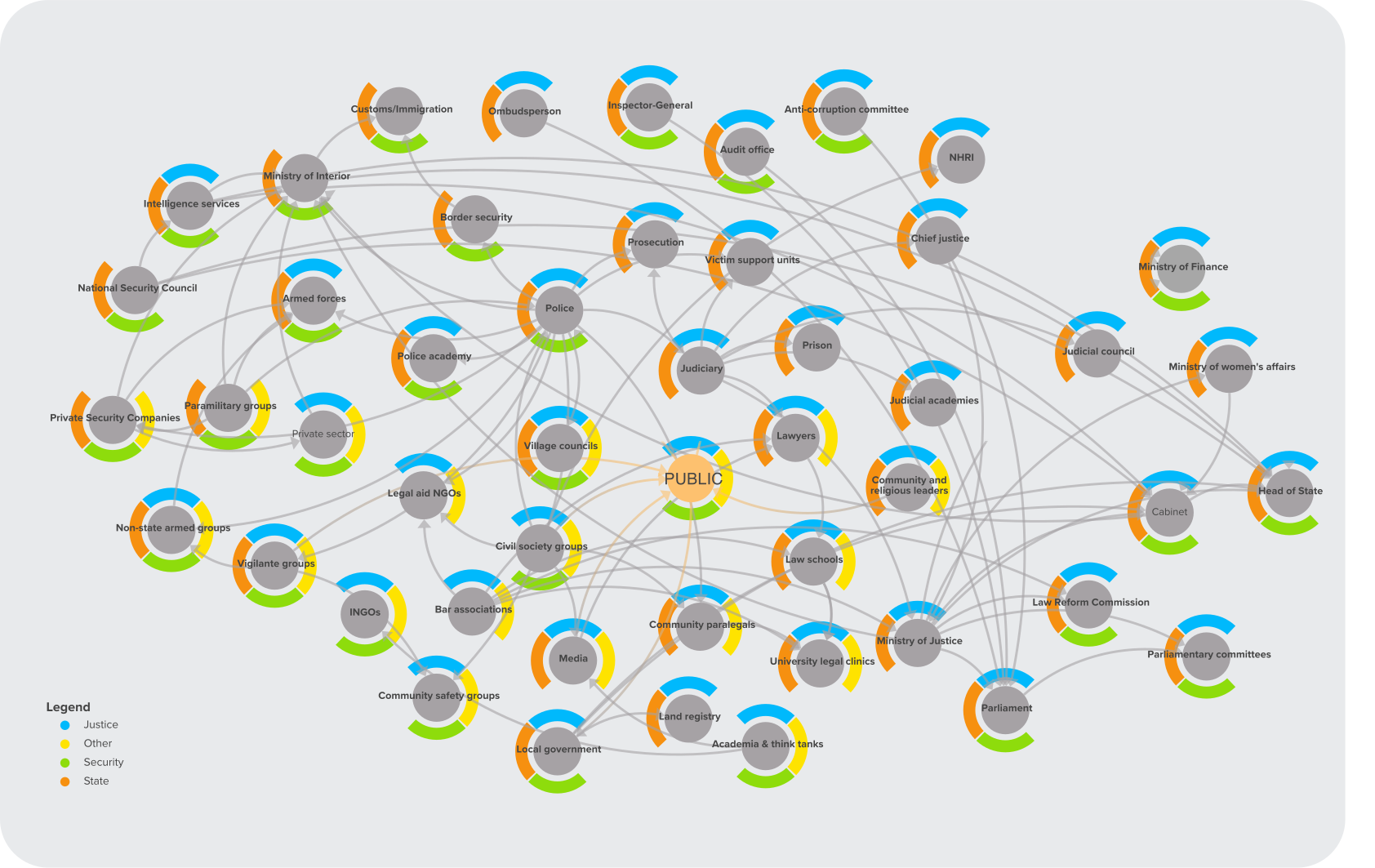
The stakeholder map below is taken from The UNDP People-Centred Approach to Justice and Security (see p. 25). It shows how people’s justice and security experiences are shaped by interactions across multiple State, non-State and hybrid actors, often in parallel or overlapping ways.
Key considerations for people-centred justice and security programming:
- Move beyond traditional categories. Mapping should include State, non- State and hybrid actors, such as judges, police, customary leaders or elders, paralegals, militia groups, or local authorities.
- Pay attention to overlapping roles. Drawing rigid lines between “justice” and “security” actors can obscure how they function in practice. Security actors may regularly play justice-related roles, such as helping resolve local disputes. A community leader might assist individuals with justice problem while also managing community-level conflicts.
- Recognize informal influence. Power and legitimacy are not always tied to formal mandates. Influence may stem from trust, access to information or control over resources.
- Include less visible but influential actors. These may include frontline service providers or influential figures who shape decisions behind the scenes. For example:
- Civil registry officials can determine access to identity documents. Such access is often essential for claiming basic rights (e.g., the right to vote, to own property, to an education) yet is typically viewed as administrative rather than justice-related.
- Institutional actors such as chiefs of staff, as well as senior experts or advisers, can shape which justice and security issues are prioritized, how they are resourced and how they are framed politically.
- Social workers or health workers support cases such as domestic violence or child custody yet are often excluded from justice reform discussions.
- Religious or customary leaders resolve land or family disputes through community-based mechanisms, often without using “justice” terminology.
- Political parties influence justice and security through control of local councils, appointments and budget decisions, shaping both opportunities and resistance to change.
- See the system as dynamic. Roles and relationships shift over time, particularly in conflict-affected contexts. Stakeholder mapping should be updated regularly to reflect changes in power, alliances or social expectations.
- Analyse relationships and interdependencies. Understanding how actors relate to one another—for example, through authority, trust, coordination or conflict—helps teams identify how decisions are made, where influence is exercised and which relationships may enable or constrain change.
Stakeholder mapping supports strategic decision-making about where and how to engage and who needs to be involved to enable meaningful change. Used well, it can help identify potential entry points and partnerships, reveal hidden sources of resistance or influence and locate potential allies and change agents within the system.
Layer in PPEA
Stakeholder mapping is a critical first step in identifying who shapes justice and security systems. But to understand how these systems function and how change can happen, teams must also explore what drives or resists transformation. This Guide treats PPEA as a single integrated tool, recognizing that political economy drivers cannot be understood without analysing how power is held, exercised and contested. PPEA helps unpack the underlying interests, incentives, institutional arrangements and relationships that influence justice and security outcomes.
PPEA combines two essential dimensions. The power analysis dimension focuses on how influence operates: who holds it, how it is exercised, and how it shapes behaviours, choices and relationships within the system. It includes both visible and hidden forms of power, such as formal authority, informal influence, access to resources or control over public narratives, and helps identify how legitimacy is established and which actors shape the enabling environment for change.
The political economy dimension examines how political, social and economic factors interact with institutions and actors to influence decisions, block or enable reform, and determine how power and resources are distributed. It considers both formal (State) structures and informal rules, interests and incentive systems, as well as broader political settlements or elite bargains that determine who does or does not have access to justice and security.
PPEA helps teams understand the operating context, assess pressures for or against change, and develop politically feasible and realistic strategies. It can identify how actors, alliances and behaviours might shift over time, and where entry points may exist.
When used together, power analysis and PEA can help teams to:
- Identify the actors and alliances that can enable or block change
- Understand who benefits from the current system, and who may lose from reform
- Recognize how incentives, interests and ideas interact to shape behaviour
- Design programming strategies that are realistic, adaptive and politically informed.
In-depth PPEA can reveal the systemic drivers of exclusion, power imbalances or institutional resistance to change. However, people-centred programming also requires ongoing, real-time political analysis that is embedded in day-to-day decision-making and responsive to shifts in context. Tools such as everyday political analysis (EPA) or “light-touch” mapping exercises such as the Stakeholder Influence Tool (see Annex 4) support real-time political analysis throughout the programme cycle.
These tools are particularly important in justice and security programming, where institutions are often deeply politicized and embedded in broader power dynamics. In many contexts:
- Security actors are not only enforcers of the law but also political and economic players. They can wield coercive power, control access to justice or services, and may participate in markets or informal economies.
- Justice providers may be accountable not to the public, but to political elites, donors or religious authorities.
Understanding these dynamics is essential to avoiding harm and identifying entry points for people-centred change.
Key considerations for people-centred justice and security programming:
- Go beyond formal mandates. Understand what actors actually do, who they are accountable to, whose interests they serve and what shapes their behaviour.
- Uncover hidden interests and informal rules. Barriers to justice and security are often political, not technical. Understanding informal norms, gatekeepers, patronage systems and sources of legitimacy helps explain why reforms stall or trigger backlash.
- Understand justice and security as political arenas. These sectors determine how power, rights and protection are distributed. These issues are inherently political and often contested.
- Map competing sources of legitimacy and control. Customary authorities, armed groups, political elites, religious leaders and other powerholders can all influence how justice and security are delivered or withheld.
- Account for economic incentives. Justice and security actors may rely on income from unofficial sources such as user fees, fines or parallel economic activities. This can influence their behaviour and priorities.
- Assess alignment with human rights. Use UNDP’s Human Rights-Based Approach (HRBA) Toolkit to assess whether justice and security frameworks align with international human rights obligations and constitutional guarantees. Identify areas where exclusion is not simply a service delivery gap, but a violation of legally recognized rights.
PPEA helps teams navigate risks, identify opportunities and design realistic rights-based programming. By grounding justice and security programming in political and institutional realities, teams can improve the relevance, impact and sustainability of their work.
Understand conflict dynamics
Conflict analysis is essential for understanding how justice and security systems function, particularly in contexts affected by conflict, crisis and fragility. It helps teams identify the dynamics that drive exclusion, violence and contestation, and informs the design of contextually relevant, politically aware and conflict-sensitive interventions.
Justice and security institutions are often shaped by, and can contribute to, conflict dynamics. They may reinforce exclusion or impunity, reflect contested authority, or be perceived by communities as biased or as parties to conflict. Understanding how these institutions are embedded in local conflict systems helps teams assess whether interventions are likely to reduce tensions, trigger resistance or unintentionally exacerbate existing grievances.
Conflict analysis not only helps teams avoid harm; it also identifies where justice and security systems can actively contribute to conflict prevention and transformation. It enables programming to reinforce social cohesion, support peaceful dispute resolution and address grievances before they escalate. It can also help pinpoint where interventions can build trust, reduce structural violence and support inclusive governance.
Teams can draw on UN and partner expertise to ensure analysis remains politically aware and conflict-sensitive. For example, UNDP/DPPA Peace and Development Advisors (PDAs) are a valuable resource, offering political insight and facilitating dialogue across UN entities and national partners.
Key considerations for people-centred justice and security programming:
- Identify local drivers of insecurity and injustice. Disputes over land, identity, resources or political representation are often at the heart of conflict. These dynamics shape how people seek justice or safety, and who they trust to provide it.
- Recognize how institutions reflect or reinforce power dynamics. In many contexts, justice and security institutions are perceived as biased, abusive or inaccessible. Conflict analysis helps explain how these perceptions arise, who benefits from the status quo and how institutional practices may aggravate or mitigate tensions.
- Assess exclusion, impunity or inequality. Analysis should examine whose interests are protected, which groups are marginalized and how institutional behaviour affects perceptions of legitimacy and fairness. It should consider how different groups experience injustice and violence, recognizing that conflict dynamics often have gendered, generational, ethnic or geographic dimensions.
- Understand perceptions of justice and security actors. These actors may be seen as neutral service providers, partisan actors or conflict parties. Perceptions shape trust, legitimacy and people’s willingness to engage with institutions.
- Anticipate risks and resistance. Interventions may provoke backlash or resistance from actors who fear losing power, legitimacy or control. Conflict analysis helps in identifying these risks early and adapting accordingly.
- Identify opportunities for transformation. Conflict analysis can highlight existing peacebuilding, mediation or justice efforts, such as through community-led initiatives, informal mechanisms or alliances between State and non-State actors. Linking these to institutional reform can help generate local ownership and momentum for change.
Conflict analysis overlaps with PPEA. Together, they uncover how violence, authority and contestation shape systems and influence access to justice and security. Conflict analysis is not just a diagnostic tool; it identifies entry points, partnerships, risks and priorities, and helps ensure programming remains responsive to shifting dynamics. It can be conducted in light-touch or in-depth ways, depending on the context, stage of programming and available resources. It should be treated as an iterative process that evolves alongside programming.
Map the system
Systems mapping brings together the insights from stakeholder mapping, PPEA, and conflict analysis to better understand how and why a justice or security system produces specific outcomes for people. It is not about identifying solutions upfront, but about understanding the dynamics that sustain current outcomes and revealing potential entry points for strategic change.
Rather than focusing on individual problems or actors, systems mapping helps teams visualize how the system functions as a whole, how different elements interact, how and why problems persist, and where change is possible (see Box 16).
Systems mapping focuses not on what the problems are, but on how they are sustained.
Systems mapping matters because persistent problems rarely stem from a single source. In complex systems, problems are shaped by relationships between actors, institutional incentives and feedback loops that reinforce the status quo (see Box 17).
Systems mapping supports programming that moves beyond technical fixes or siloed interventions and instead targets the underlying dynamics that shape outcomes for people through integrated, strategic and adaptive responses.
At its core, systems mapping involves identifying and visualizing the elements of a system and how they interconnect, influence each other and produce outcomes. While this may result in a literal visual “map”, the real value lies in the insights the process generates. The goal is to support strategic reflection, reveal hidden dynamics and identify potential entry points for change.
Systems mapping is a participatory process. It supports teams and partners to build a shared understanding of how the system operates, where it is stuck and where small, strategic interventions could unlock broader change. Systems maps should evolve throughout the programme cycle, being refined as teams deepen their understanding of the context and engage with new actors and perspectives.
There are many ways to do systems mapping, from light-touch pen-and-paper exercises such as cluster mapping, to more in-depth processes. For example, the UNDP portfolio approach supports structured workshops, facilitated inquiry, and sensemaking sessions. The approach has been applied in contexts such as Ukraine and Peru to co-create system maps with partners and drive adaptive, systems-informed programming.
Key considerations for people-centred justice and security programming:
- Embrace the messiness. Systems mapping is not about neat solutions or polished diagrams. It is a tool for exploring complexity, not resolving it. Relationships in justice and security systems are rarely tidy. Messy, overlapping connections often reflect the most valuable insights. Resist the urge to impose order too early. Allow the mapping process to surface tensions, gaps and contradictions that may reveal entry points for deeper change.
- Focus on relationships and dynamics, not just institutions. Mapping should reflect how justice and security services are actually experienced by people, not just who delivers them. Consider how decisions are made, who influences them and what dynamics sustain inequality or exclusion.
- Make feedback loops visible. Feedback loops can reinforce trust and safety or perpetuate violence and impunity. Mapping helps identify where programming might strengthen positive loops, such as community-police cooperation, or interrupt harmful ones, such as cycles of corruption and mistrust (see Box 17).
- Identify leverage points. Systems maps help locate areas where small, strategic shifts could ripple out to support broader change.
- Community paralegals can improve access to justice in one location, but the ripple effect may include increased legal awareness and reduced reliance on unfair informal dispute resolution. Paralegals can also highlight systemic issues, prompting improved institutional responsiveness and broader reforms.
- Court user help desks and publicized service charters can shift power dynamics by helping people to better navigate justice processes and understand and claim their rights. They create pressure on institutions to meet service standards, which can lead to simplified procedures, improved staff responsiveness and greater public trust.
- Embed local perspectives. Systems maps are built from the perspectives of those doing the mapping. Including diverse perspectives, especially the perspectives of people with everyday experience of injustice or insecurity, is essential to understanding how a system is perceived and where it breaks down in practice.
Use mapping to support strategic reflection. The goal is not just to create a picture of the system, but to use it to guide strategic choices. Once patterns and relationships are visible, teams should step back and ask, “What does this mean for where and how we intervene?” Mapping should help test assumptions, identify leverage points, anticipate risks and prioritize where small, strategic shifts could create meaningful change.
These tools build the foundation for diagnosis (Section 4.7). They help teams move from understanding how the system functions to identifying why it produces exclusion, harm or distrust, and where the potential for sustainable change lies.
4.7 Diagnosing the problem: connecting people’s experiences and system dynamics
Diagnosis builds on systems mapping by helping teams understand why the system produces exclusion, harm or distrust, and what would need to shift for change to be possible. It connects people’s needs and experiences (Section 4.5) with system dynamics (Section 4.6), helping teams to reach a shared, strategic understanding of the problem. Diagnosis is not a standalone task. It emerges from this broader process of inquiry.
A strong diagnosis is grounded in evidence, shaped by diverse perspectives and useful for decision-making. It creates the foundation for strategic collaboration by enabling stakeholders to align around a common understanding and define a collective approach, even if they come from different perspectives, interests or sectors.
The diagnosis process can also be critical for shifting donor assumptions. Step 1 analysis can help challenge misconceptions and highlight where donor investment could support meaningful change. This makes robust diagnosis a strategic asset for both programme design and resource mobilization.
Diagnosis is most effective when it includes a range of actors, such as UNDP teams, government partners, donors, civil society and affected communities. Participatory diagnosis deepens understanding, builds ownership and identifies entry points that are both politically feasible and socially relevant.
It is often a natural outcome of the systems mapping process. As teams explore how the system functions, they begin to see why it produces the outcomes it does. Diagnosis emerges through facilitated inquiry, sensemaking workshops or participatory mapping sessions. Several tools can support this process. One of the most commonly used is the iceberg model.
4.7.1 The iceberg model: A tool for systemic diagnosis
The iceberg model is a visual metaphor from systems thinking that helps identify deeper causes of persistent problems. It helps teams to move from surface-level descriptions of “what is wrong” to a deeper understanding of why it keeps happening and what beliefs, assumptions or incentives are keeping it in place.
The model breaks down issues into four levels:
- Events: What we see happening (e.g., a protest, displacement, conflict outbreak).
- Patterns/trends: Recurring events over time (e.g., recurring ethnic tensions during elections).
- Structures/systemic causes: The systemic factors driving these patterns (e.g., exclusionary governance, inequitable service delivery, weak accountability systems).
- Mental models: Deep beliefs, values, norms or assumptions that shape system behaviour (e.g., ethnic mistrust, gender bias).
A justice and security example could be:
- Event: A surge in vigilante violence.
- Pattern: Repeated use of vigilantes where police are absent or mistrusted.
- Structure: Weak justice institutions, low police presence, poor grievance resolution.
- Mental model: Belief that “only force ensures order” or “the State cannot protect us”.
The iceberg model helps teams and key stakeholders look beyond surface-level fixes, such as more police training or equipment, and focus on underlying system shifts, such as improving institutional legitimacy, rebuilding public trust and addressing harmful social norms. See how UNDP Panama used the iceberg model here.
4.7.2 Other tools for collaborative and systemic diagnosis
UNDP is increasingly adopting tools drawn from systems thinking to deepen its understanding of complex problems, in line with its portfolio approach. These methods support collective sensemaking, reveal hidden dynamics and help identify leverage points for change. They include:
Deep Demonstrations: A systems innovation approach that supports collective sensemaking and the identification of strategic entry points.
Sensemaking: A strategic process to extract insights from current UNDP projects and to generate actionable learning.
Foresight and anticipatory governance: These approaches help teams explore multiple futures, examine emerging risks, and rethink current assumptions. They can be particularly helpful in politically volatile, fast-changing or reform-resistant environments.