

Key messages
- Learning, reflection and adaptation are integral to delivering people-centred justice and security.
- Programming operates in complex and dynamic environments that require adaptive responses.
- Data, feedback, and evidence support real-time decision-making and strategic course correction.
- Institutionalization strategies help embed change in systems and strengthen sustainability.
- Scaling focuses on deepening impact and responsiveness, not just expanding reach.
6.1 Introduction
People-centred justice and security programming is not static; it must evolve as needs shift, contexts change and new insights emerge. Step 3 focuses on how teams can use evidence and experience to adapt interventions, scale what works, and embed change within justice and security systems.
In this approach, adaptation is not just a technical adjustment; it is how systems become more inclusive, fair and responsive to the people they serve. While Step 2 focused on establishing the infrastructure for learning through testing, Step 3 turns that learning into action: making real-time improvements, ensuring adaptations are locally relevant and sustained, and embedding change that can last.
This step explores five aspects of adaptation, visualized in Diagram 7: Step 3 at a glance—Adapt and evolve interventions:
- Reflect and learn (Section 6.2): How teams can use structured reflection and learning, including through community engagement and evaluations, to assess progress, challenge assumptions and generate new insights to guide programming.
- Learning-driven adaptation (Section 6.3): How to adjust interventions in response to evidence, evolving needs and shifting context, while remaining focused on long-term people-centred outcomes.
- Designing for scale (Section 6.4): How to identify what works, assess readiness for scale, and expand, deepen, or institutionalize impact in ways that reinforce people-centred principles.
- Embedding and sustaining change (Section 6.5): How to institutionalize people-centred principes and practices in institutions, structures, behaviours and relationships across the system to support lasting transformation.
- Navigating change and volatility (Section 6.6): How to stay responsive in complex, uncertain and rapidly changing environments through adaptive, politically informed programming.
Diagram 7: Step 3 at a glance—Adapt and evolve interventions
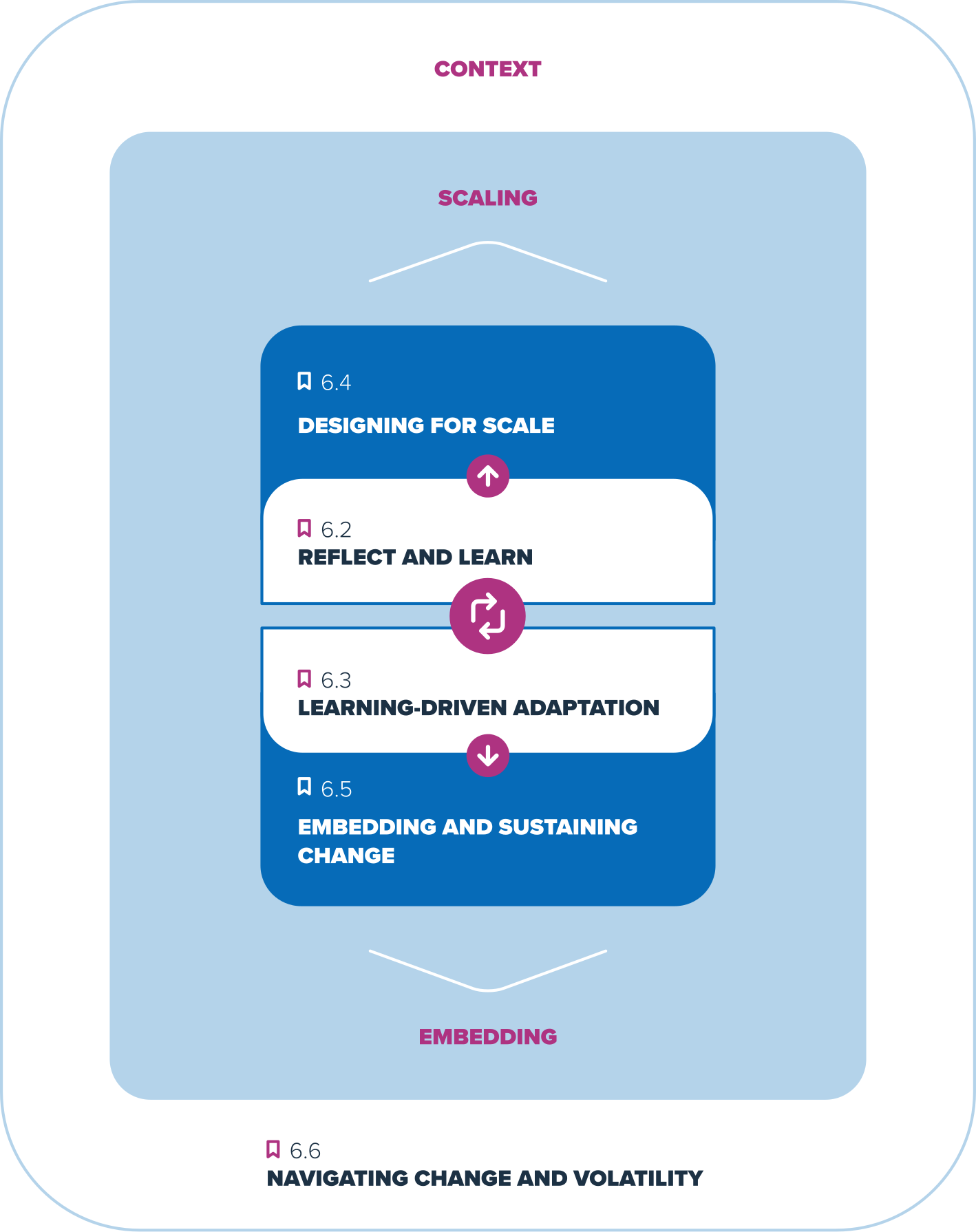
These elements are not sequential. They form part of a continuous cycle of learning, reflection and adaptation that helps programming remain effective, inclusive and responsive over time. Together, they support justice and security systems to evolve in ways that better serve people, especially the vulnerable, marginalized and those most at risk of being left behind.
6.2 Reflect and learn
Reflection is the foundation of adaptive, people-centred programming. It involves critically examining what happened, how it happened and why, drawing on the experiences of implementation and the perspectives of diverse stakeholders. It helps reveal tacit knowledge, identify blind spots and assess how contextual changes may influence results. Reflection allows teams to question assumptions and make informed course corrections. It is an essential ingredient for learning and continuous improvement.
Learning builds on reflection by generating and using insights to shape future decisions. It is about not only identifying what worked but also understanding for whom, in what conditions and why. Learning enables teams to adapt interventions in ways that are grounded in evidence and shaped by experience.
People-centred programming encourages reflection at multiple levels: within teams, with partners and with affected communities. It focuses on whether interventions are improving people’s experiences of access, fairness, trust and safety, and considers shifts in behaviour, relationships, capacities and institutional processes as signals of systemic change.
Teams should build in regular opportunities to reflect and learn throughout the project cycle. Three approaches that commonly used within UNDP and are particularly useful are structured internal reflection, participatory feedback and community engagement, and people-centred evaluations.
- Structured internal reflection Tools such as AARs, reflection sessions and sensemaking help teams assess what is changing, why it matters and how to respond. These tools support real-time learning and cultivate a culture of adaptation.
- AARs are typically used after specific events or activities. They help teams to ask: What was planned? What actually happened? What worked well? What could be improved next time? They are practical and fast (lasting between 30 and 60 minutes) and help improve day-to-day implementation and delivery.
- For tips on how to run an AAR, see resources from BetterEvaluation, indeed, or NASA Appel Knowledge services.
- Reflection sessions offer a broader look at progress, assumptions, and strategic direction. These sessions help teams to answer broader questions: Are we seeing the change we hoped for? What is emerging in the context? Are we still doing the right thing in the right way for the right people? Reflection sessions are most valuable when they include a diverse range of project-related stakeholders. They provide an opportunity to reflect on what is actually happening in the work, discuss unexpected developments and agree on next steps.
- Sensemaking can deepen these processes by helping teams identify patterns and interpret emerging data, especially in complex or uncertain environments. It can be used in light-touch formats (e.g., a short discussion using guiding questions) or as a structured workshop, such as UNDP’s portfolio sensemaking approach. When used regularly, sensemaking helps connect individual observations to create shared insight and supports more coherent and adaptive decision-making.


Participatory feedback and community engagement When participatory feedback and community engagement processes are well documented and reflected upon, they provide insight into what is changing, for whom and why. This evidence can then feed back into programme learning and adaptation.
- Participatory processes help teams hear directly from affected communities, co-interpret findings and understand how interventions are experienced in people’s daily lives. They help teams identify blind spots, improve relevance and adapt in real time. Examples of participatory processes include:
- Feedback sessions with community members during or after interventions.
- User feedback tools, such as surveys or mobile platforms, to gather perspectives on access to justice or perceptions of community safety.
- Structured listening exercises to capture evolving concerns.

- Community engagement processes such as community conversations and dialogues are designed to strengthen trust, promote participation and inclusion, and support collaborative problem-solving among local communities and authorities. While they are not monitoring tools per se, they can reveal valuable insights into how people experience justice and security systems, what is changing, and where adaptation may be needed.
People-centred evaluations While continuous reflection and adaptation are essential throughout the project cycle, evaluations provide a structured opportunity to step back and assess progress. Mid-term and end-of-project evaluations are important tools, especially when used to generate learning rather than simply meet accountability requirements. Outcome, portfolio, participatory and impact evaluations are also critical for understanding deeper change, testing what works, for whom and why, and informing strategic decisions. When designed and used effectively, evaluations support learning, strategic adaptation and the advancement of the people-centred approach.
According to the UNDP Evaluations Policy (2019) and accompanying guidelines, evaluations should be:
- People-centred, focusing on how interventions enhance people’s capabilities, choices and rights of all people.
- Useful and timely, feeding into planning and decision-making processes.
- Inclusive and participatory, incorporating feedback from affected communities, institutional partners and stakeholders.
A people-centred evaluation asks not only “Did it work?” but also:
- “For whom did it work?”
- “Why?”
- “How did it change people’s justice and security experience?”
Evaluations can strengthen results and promote adaptive management when:
- They are embedded in programme cycles as opportunities for learning, adaptation and strategic decision-making.
- Their timing aligns with key decision points.
- They focus on generating insights, not just accountability.
- Findings are shared, discussed and absorbed by teams and partners.
- Lessons inform strategy revisions, programme redesigns or the next phase of implementation.
However, many evaluations in justice and security programming do not fully assess outcomes or impact. They often focus on outputs (what was delivered) or processes (how well the intervention was implemented) without sufficiently examining the results that matter most to people, such as improved access to justice, increased trust in institutions or reduced violence. A people-centred lens shifts the focus towards understanding what changed, for whom, and whether those changes are contributing to a more inclusive, just and secure society.
Impact assessments can help fill this gap. They offer a flexible way to examine whether interventions are contributing to meaningful short- and medium-term change. While not always designed to prove causality, they can assess whether people are experiencing improved access to justice, feel safer or more empowered, or view institutions as more responsive or fair. Used alongside output and outcome monitoring, they provide timely insights to support adaptation, learning and evidence-based decision-making.
Impact assessments can include or overlap with impact evaluations, which use specific designs to assess causal effects. They can also draw on participatory or empowerment evaluation methods that place people’s voices at the centre of inquiry and build local ownership of evidence. Impact assessments can be used in a variety of ways, including to establish a baseline, explore emerging outcomes (such as behavioural change, improved relationships or increased confidence in services), or assess intermediate outcomes emerging during implementation. This requires adequate resourcing and capabilities, including skills, time and funding to design and deliver people-centred and impact-oriented assessments and evaluations.

6.3 Learning-driven adaptation
Reflection helps teams pause, make sense of complexity and deepen their understanding of context. Turning reflection into action is a key part of the adaptive, people-centred approach.
People-centred justice and security challenges are embedded in complex systems— that is, systems with many interacting parts, unpredictable dynamics and non-linear change. This means it is not fully possible to predict outcomes of interventions from the outset. As interventions unfold, new dynamics emerge, and the original programming assumptions may no longer hold. Adaptation is necessary to stay effective.
Adaptation is a deliberate and evidence-based response to changing needs, shifting contexts or increased understanding. Adaptation may involve shifting the programming approach or focus, changing the target group or intervention location, redesigning or dropping activities, or adding new partnerships. It can include adjustments to ongoing interventions and decisions about where and how to expand programming areas in response to what is being learned. While outputs and activities may shift, the intended outcomes and impacts remain the anchor. Adaptation helps identify more effective, inclusive and contextually relevant pathways to achieve them.
Adaptation is about strengthening what works while not losing sight of intended outcomes and required accountability.
To adapt effectively, teams must translate learning into action. This begins with identifying what implications a new lesson has for the theory of change or the project. Does it challenge an existing assumption? Reveal a gap? Signal an opportunity? The answers to such questions can help teams determine what programming shift is required.
Once the implications of learning are identified, teams should clarify: Who needs to know about and make decisions based on learning? How should information be presented to support decision making? And who will be responsible for implementing the decision? Documenting and sharing learning and the rationale for proposed adaptations is essential for engaging implementing partners, senior management, donors and others throughout the adaptation process. Regular updates, joint reviews and shared reflection spaces can foster shared ownership, enable timely feedback and strengthen trust. They can also support capacity building of partners to more effectively deal with complex problems.
Transparent communication helps ensure that adaptation is seen not as a sign of project failure, but as a strategic response to learning and complexity. For example, adaptation that is evidence-based, transparent, responsive to people’s experience and well documented is often welcomed by donors who want to see impact for their investment.
Adaptation enables programmes to remain relevant and effective in dynamic contexts. As learning is applied and interventions evolve, opportunities often emerge to expand what works and to anchor successful approaches within systems. The next sections explore how teams can scale effective practices and embed lasting change through institutionalization.


6.4 Designing for scale
Scaling builds on adaptive learning. Once promising approaches emerge through experimentation and adaptation, the next step is to consider how to expand, deepen or institutionalize their impact.
Scaling is not just about reaching more people. It is about amplifying impact, embedding what works, and strengthening justice and security systems in ways that are sustainable, inclusive and locally owned. In this context, scaling must go beyond expanding coverage (e.g., more model police stations) or increasing service numbers (e.g., greater numbers of people accessing legal aid). It must also focus on improving the quality of justice and security services and shifting systems to become more accessible, inclusive, fair and accountable, especially for those most at risk of being left behind.
This section explores how people-centred justice and security programming can design for scale in a way that supports system transformation. It examines different types of scaling, how to assess readiness for scale and pitfalls to avoid. It offers practical guidance for teams to embed a scaling mindset into the design of any justice and security intervention. This means planning from the outset for how promising approaches can evolve into broader, deeper and more sustainable change.
UNDP defines scaling though the HRBA, which emphasizes both the outcomes (availability, accessibility, and quality of justice and security services) and processes (participation, non-discrimination and accountability) that make formal and informal justice and security mechanisms legitimate and sustainable.
“Scaling up is about ensuring the quality of a development impact, reaching out to those ‘left behind’ and ensuring the sustainability and adaptability of results. It is not about just replicating successes to cover larger groups or populations.”
UNDP, Guidance Note: Scaling Up Development Programmes, p. 7.
Designing for scale includes identifying what conditions will enable impact to grow, what capacities and partnerships (both local and international) are needed to support it, and how implementation can adapt to different contexts. It also requires thinking systemically about how to shift mindsets, influence rules and behaviours, and build the coalitions and feedback loops needed to sustain transformation over time.
Designing for scale begins with clarity on what type of change is sought and how it contributes to a more people-centred justice or security system.
6.4.1 Scaling as a strategy for system change
Scaling should be seen as a way to embed people-centred principles across justice and security systems—within formal institutions, community-based mechanisms, and the relationships between them. Accomplishing this requires adopting the following approaches.
Embed fairness, accessibility, inclusion and accountability at all levels People-centred principles must shape how justice and security are experienced in everyday life. They should inform not only laws and policies but also the daily practices of justice and security actors. These include local dispute resolution practices, oversight mechanisms, community safety initiatives, and interactions with paralegals, safety committees, traditional authorities, and others. People-centred principles help ensure that justice and security systems are not only effective but also trusted, responsive and grounded in the realities of the communities they serve.
Ensure institutions and actors can respond to diverse justice and security needs Challenges vary by context and community. Effective response requires that actors, from police to paralegals, elders to civil society, have the space and capacity to adapt. This may include resolving disputes through dialogue or working across formal and informal systems. At the same time, all actors (whether State, non-State or hybrid) must uphold basic rights and be accountable to both their institutions and the communities they serve.
Shift systems to prioritize conflict prevention, rights protection and trust-building In contexts where State legitimacy is weak or contested, justice and security institutions may be seen as sources of fear or discrimination. Scaling people-centred approaches means investing in prevention and trust-building; promoting rights-based policing and accountability; and recognizing the long-term value of legitimacy through trustworthy, fair, and accountable actions, over short-term rules enforcement and control. Systems must be built to serve all people fairly, not just to enforce law and order.
Expand impact in ways that reinforce local ownership and legitimacy In many settings, people access justice and security through a mix of formal and informal pathways, such as customary courts, religious leaders or community safety groups. Scaling requires engaging with these existing practices; understanding which contribute to or undermine accessibility, fairness, and accountability; and identifying opportunities for reform. This helps to avoid imposing external models that may be seen as foreign or illegitimate, and strengthens alignment with community values, needs and expectations.
6.4.2 Types of scaling
Scaling can take multiple forms, depending on the goals, context and systems involved. Understanding these pathways from the outset helps teams design interventions that are both scalable and impactful.
In a people-centred approach, scaling goes beyond replication or “going national.” It may involve expanding to new locations, influencing national policies or deepening impact where work is already under way. Scaling becomes transformational when it embeds people-centred principles into how systems operate, and drives shifts in norms, behaviours and power relations.
The complex nature of justice and security systems means what works in one part of the system may not work elsewhere. Scaling should therefore be seen as a flexible, ongoing process, that combines different strategies or types of scale depending on the context.
There are four main types of scaling:
Horizontal scaling (scaling out). This type of scaling involves achieving greater reach by expanding a tested approach to new locations or population groups. An example of horizontal scaling would be expanding mobile courts, legal aid clinics or restorative justice forums to underserved areas.
Vertical scaling (scaling up). This involves institutionalizing a successful approach through laws, policies, budget allocations or institutional mandates. An example would be adopting a national legal aid strategy based on lessons from pilot projects.
Functional scaling. This type of scaling focuses on deepening or improving the function and performance of an existing intervention by enhancing its quality, inclusion, sustainability or efficiency. An example would be upgrading judicial processes to reduce case backlogs, increase accessibility or improve service responsiveness.
Transformative scaling (scaling deep). This seeks to shift social norms, behaviours or power relations across systems and communities. It often requires a combination of tailored interventions and scaling strategies that adapt to local contexts, needs and opportunities. An example would be transforming police services by shifting institutional culture, values and behaviours to promote trust, inclusion and community-oriented policing.
6.4.3 Readiness for scaling
Not every promising initiative is ready to scale. Before investing in scale, teams should assess whether the necessary foundations are in place.
Scaling should be guided by the foundational principles of people-centred justice and security: human rights, inclusion and participation, empowerment, local ownership, and accountability. These serve as benchmarks for assessing whether an intervention is ready for scale and whether scaling will reinforce its people-centred impact.
Scaling should not be automatic or assumed. It must be strategic and grounded in evidence. Interventions should only be scaled when they have demonstrated meaningful results and show clear potential to deliver sustainable, inclusive and locally owned impact at scale.
Factors to be considered when assessing readiness for scaling include:
- Impact: Has the initiative demonstrated meaningful and sustained outcomes, especially for those most at risk? Has the intervention improved access, trust, safety or accountability?
- Institutional demand: Is there political backing and technical capacity to adopt or absorb the intervention? Is there support and commitment from ministries, institutional leadership, local authorities or judicial bodies?
- Feasibility: Are there enabling conditions or champions for scale? Could it provoke resistance from power holders or entrenched interests? Is there political leadership and commitment to sustain change across political cycles?
- Adaptability: Can the intervention work in diverse contexts without losing its people-centred focus? Has it been tested in different contexts (urban/rural, stable/volatile, formal/informal)?
- Inclusion and accountability: Will scaling strengthen or undermine inclusion, trust and rights? Could scaling reinforce harmful practices?
- Sustainability: Are there mechanisms to ensure quality control, learning and institutionalization? Can community engagement be maintained over time?
- Integration: Can the approach be sustained by UNDP or in partnership with other UN agencies or development partners? Are there opportunities to combine or align with other activities working on similar issues or engaging the same stakeholders?
- Resourcing and funding: Are sufficient financial resources available, or is there a clear strategy to mobilise them? Will the intervention remain viable if external funding declines?
Effective scaling lays the groundwork for sustaining change. Section 6.5 explores how to embed people-centred approaches into the rules, incentives, behaviours and capacities of institutions, ensuring that progress endures and systems continue to evolve in response to people’s needs.
6.5 Embedding and sustaining change
Embedding change ensures that what works is not just scaled but becomes part of the system’s architecture. It means incorporating people-centred principles and practices into the structures, rules, routines, relationships, and values that shape institutions and behaviour across the system. It requires working with the full ecosystem of justice and security providers, including State institutions, community-based actors and hybrid mechanisms, recognizing that all contribute to people’s experiences of justice and security.
Where transformative scaling seeks to deepen and expand system-level change, embedding ensures that change survives beyond projects, personalities or external funding cycles. Embedding change ensures that transformation becomes “how the system works.”
This means moving beyond temporary projects or donor-driven activities to build sustainable public functions and community-based practices that are owned and led by national or local actors. It requires translating tested approaches into laws, policies, mandates, budgets, institutional cultures and local practices, in partnership with government and community actors. It also involves embedding people-centred ways of working into daily practice, ensuring that fairness, dignity, participation and accountability are reflected in how justice and security are delivered, whether by State institutions, community-based actors or hybrid arrangements.
Justice and security systems are not simply technical structures, but complex social systems rooted in relationships and power dynamics. Sustaining change across a system requires people. Transformative reforms take root not just through policies and procedures, but through the behaviours, relationships and shared values of those who enact them:
- When institutional leaders, community authorities, and other influential actors model people-centred principles in their daily work, they reinforce trust and signal that these values are core to institutional identity and public accountability.
- Change is more likely to stick when it is shaped by those who live it: reforms that respond to people’s experience, leverage local knowledge and are co-designed with affected communities tend to be more legitimate, resilient and adaptive over time.
- People-centred systems change is rarely driven by a single actor. It is sustained through networks of individuals (change agents, champions and connectors) who span institutions and communities. These networks foster shared purpose and help align behaviours across diverse parts of the system. Supporting such networks can help embed change even as leadership or political conditions shift.
“Embedding” means supporting and enabling people within the system to drive change from the inside.
Institutionalizing people-centred approaches means embedding not just specific practices, but also the core principles that underpin them. They serve as practical benchmarks for assessing whether institutionalization is truly people-centred. Each principle is illustrated below with examples of how it can be embedded in practice.
- Human rights: Embedding rights protections into laws, service charters, or codes of conduct and strengthening oversight bodies, grievance mechanisms, and due diligence frameworks that hold private and public actors accountable for the human rights impacts of their actions.
- Inclusion and participation: Mandating community participation in planning processes, user feedback in service design, or participatory budgeting for justice and security services.
- Empowerment: Institutionalizing paralegal networks in legal aid structures, conducting legal awareness campaigns, or simplifying procedures that help people better understand and navigate justice systems.
- Local ownership: Ensuring approaches are embedded in local policies and structures, and are valued, led and adapted by local actors.
- Accountability: Integrating community scorecards, complaints mechanisms and external oversight into monitoring and management systems.
There is no single pathway to embedding change. Effective embedding is context-specific and often incremental. It depends on the system’s entry points, capacity and openness to change.
Practical strategies for embedding include the following:
Translating learning into formal systems. Integrate successful innovations into laws, policies, mandates, standard operating procedures, training curricula or budget lines, such as embedding paralegal networks into national legal aid structures.
Strengthening institutional capacity. Build the integrity and capacity of institutions and the people in them to deliver people-centred services aligned with human rights and service orientation.
Aligning incentives and human resource systems. Embed people-centred principles into institutional hiring practices, performance evaluations, training requirements and promotion pathways.
Embedding community engagement into institutional practice. Institutionalize mechanisms that ensure justice and security institutions routinely engage the people they serve—for example, mandating public consultations in security strategies or participatory budgeting for local justice services.
Embedding monitoring and accountability mechanisms. Incorporate user feedback mechanisms into court or police oversight structures. Institutionalize perception surveys, citizen scorecards, complaints mechanisms, or open performance data that enable public trust-building and transparent, responsive management.
Working with community-based mechanisms. Support community and hybrid mechanisms to institutionalize the practices they value and are willing to sustain. This includes building on customary or community mechanisms where they align with human rights standards.
Linking micro-level change with macro-level reform. Use data, learning and policy engagement to link community-based innovations to national reforms, connecting bottom-up insights with top-down change.
Supporting networks and coalitions for change. Support networks of reformers, change agents and community stakeholders who can collectively embed people-centred approaches into the system. Support convening, learning platforms, and informal collaboration spaces between justice and security providers and users to build shared understanding, trust and responsiveness.
Embedding is not a one-time achievement but part of an ongoing process. Justice and security systems are dynamic. They are constantly evolving in response to internal shifts, political changes and external pressures. Embedded practices and norms can erode, distort or be co-opted if they are not maintained through continued engagement, reflection and adaptation. Supporting the emergence of people-centred systems requires sustained commitment, not just to institutionalize practices and principles, but also to nurture the conditions that allow them to take root, evolve and endure over time.
Embedding is ultimately about building a constructive and accountable relationship between society (including people, communities, civil society and the private sector) and the State. When embedding is successful, it fosters mutual accountability: Justice and security institutions become more responsive to communities, and communities in turn gain greater voice and trust in the system. Over time, this helps cultivate a culture where justice and security are seen not as tools of State control, but as shared public goods rooted in fairness, human rights, accountability and responsiveness to people’s needs. This shift is at the heart of the people-centred approach.
6.6 Navigating change and volatility
Justice and security programming takes place in environments marked by complexity, uncertainty and constant change. Volatility, whether driven by conflict, political transitions, social unrest, economic shocks or environmental threats, is not an occasional disruption but a persistent condition. For people-centred justice and security programming to be effective, it must be able to adapt, respond and evolve alongside the shifting realities it seeks to influence.
Navigating change and volatility is not merely a question of managing risk; it is a strategic necessity for sustaining relevance, legitimacy and impact. This requires a deliberate shift from conventional, linear planning to adaptive, learning-driven and systems-informed approaches that can work with complexity rather than against it.
Justice and security systems operate within complex environments. They involve diverse actors, interdependent relationships, competing interests and often contested legitimacy. Change within these systems rarely follows a predictable path. Programming must therefore be flexible and responsive, with the capacity to adjust based on evidence, feedback and evolving context.
Adaptive programming offers a practical pathway to navigate volatility. It emphasizes learning by doing, iterative decision-making, and responsiveness to emerging challenges and opportunities. In practice, this means working politically, understanding power dynamics, incentives and resistance, and adapting strategies to navigate constraints while maintaining a clear focus on people’s rights, needs and expectations. UNDP’s work in contexts such as Somalia, Yemen, Myanmar, Afghanistan and Guatemala has shown how adaptive approaches can strengthen the relevance of, trust in, and impact of justice and security programming, even amid significant constraints. It highlights that there are no blueprint solutions. Effective responses are discovered through ongoing analysis, experimentation and learning.
The following strategies offer practical ways to navigate change and volatility.
- Integrate power and political economy analysis into everyday programming. Use PPEA to understand power dynamics, anticipate shifts and identify opportunities to influence change. This includes regular, informal analysis by teams in close contact with the context.
- Apply scenario planning as part of strategic foresight to explore different possible futures, test assumptions and develop flexible strategies for action. This supports anticipatory decision-making and helps programmes navigate uncertainty with greater confidence and adaptability.
- Build strategic capacities within teams to detect early signals, assess risks and opportunities, and respond effectively. This includes strengthening political intelligence, adaptive leadership and risk management.
- Design for flexibility in activities, partnerships and monitoring frameworks. Leave space to adjust who is involved, how interventions are delivered, and which actions are prioritized as the context evolves. Engage donors early and throughout implementation to align expectations, build trust, and ensure that programme adjustments remain supported and transparent.
- Work through diverse partnerships to remain agile. Avoid reliance on any single institution or actor. Engage both State and non-State partners who can help sustain action under changing conditions.
Use adaptive management approaches to test and refine solutions. Start with smaller-scale interventions, monitor feedback and scale up what proves effective. Adaptation should be purposeful, informed by evidence and clearly documented.
Invest in resilient information systems to generate timely data and feedback. Real-time information supports faster learning, better decisions and greater responsiveness. For example, UNDP Lebanon’s Tensions Monitoring System captures real-time data on tensions across communities to inform programming.
Support agency and co-creation by empowering local actors (State and communities) to adapt and lead justice and security responses, which strengthens resilience and promotes ownership.
This way of working reflects a wider shift in development practice. Adaptability, participation, trust and learning are not just features of good programming; they are essential capabilities for navigating risk and delivering fair justice and security outcomes in complex and changing environments.
Navigating volatility requires strategic discipline and a commitment to learning. Programmes should create space for structured reflection and adjustment throughout implementation, including tracking context changes, documenting decisions, and communicating transparently with partners and communities. These practices help ensure that programming remains responsive, grounded in real-time needs, and able to deliver meaningful results even in the face of disruption and uncertainty.